.png)
Arizona SR87 - Beeline Hwy: Rye Section Post 2 - Please pass me a girder!
Due to the water flowing down the creek and the restrictions placed by the Forest Service, setting the +/- 100 ft long bridge girders on the NB Deer Creek bridge called for a specialty operation that included approximately 6 separate synchronized crane maneuvers to safely move the 50+ ton girders from the truck to the bridge abutments. One crane is on top of the roadway and the other is in the bottom of the creek.
Before reading further, imagine trying to carry a bucket of water from a long rope without it swinging wildly and spilling. These operators were experts and deserved a lot of praise that day.
Step 1, the truck is backed up to the upper crane and the crane is attached to the lead end of the girder with a long choke cable and a specially designed triangle picking apparatus.

Step 2, the upper crane swings slowly toward the bridge as the truck backs up, keeping their motions synchronized so they don't damage or tip the crane.

Step 3, the lower crane swings out toward the upper crane and prepares to catch the loop on the triangle. The trailing end of the girder is still on the truck and backing carefully.

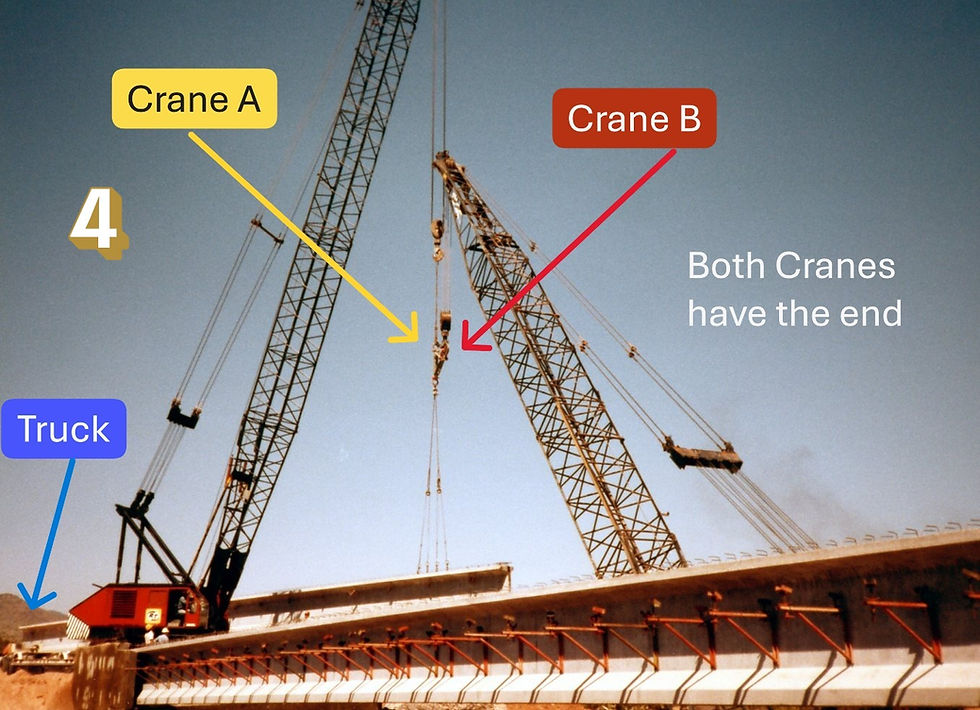
Step 4, both cranes have the lead end of the girder and slowly transfer across so the lower crane can support the load alone. During this transition, both cranes are very close to being outside their chart, meaning that a failure of one would likely cause the collapse of both.
Step 5, as the lower crane holds the lead end of the girder, the upper crane releases and swings around to hook the trailing end of the girder which is still resting on the truck.

Step 6, both cranes lift the girder and swing slowly to set the girder on the bridge abutments. Synchronized movements are critical to prevent damaging or collapsing either or both cranes. A 50 ton girder swinging into the lattice boom on the crane would cause it collapse immediately, bringing the second crane down with it.

Step 7, the project manager (me) steps behind the wing wall and pukes from the stress. We had to hire a specialty erection company to perform this work because it was so risky, our insurance carrier would not underwrite it.
Some would ask why we didn't use bigger cranes, and my answer is that in 1991 the availability of massive cranes was next to none here in Arizona and the cost to mobilize one from the midwest or the coast for just one day of setting girders was prohibitive.

Comments