.png)
Arizona SR 77 - The great girder debacle of 1985
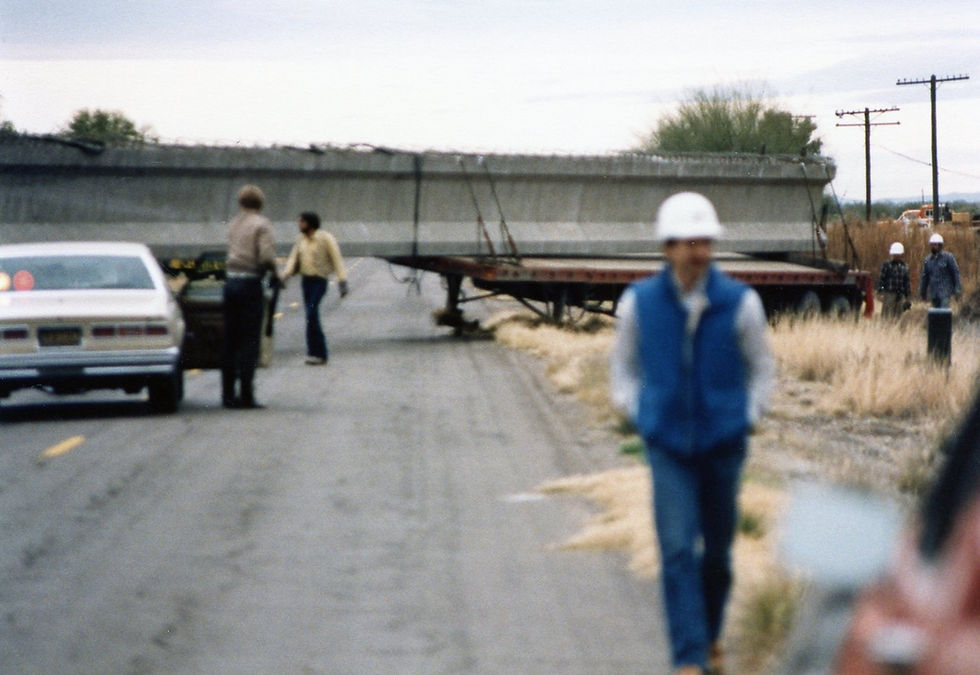
Sundt's heavy group awarded two purchase contracts to Featherlite Building Products of Texas for bridge girders to be manufactured in El Paso and transported to Tucson for both the First Avenue Bridge and the SR 77 Bridge. TPAC, an Arizona producer, while having facilities in Tucson and Phoenix was not successful, likely because they thought they had a monopoly in the market and priced their products accordingly. Upon being assigned to these projects and learning the procurement, we were all skeptical of the 20 girder per day guarantee that Featherlite had agreed to in their purchase contract.
First Ave bridge:
I started early asking Featherlite about the delivery schedule, I asked for a logistics plan to deliver 20 girders per day. Were they going to stockpile nearby and rehandle for delivery? Put a large fleet of trucks on the road? The trip from El Paso to North Tucson was very lengthy, and trucks certainly could not make two trips during our working hours.
The delivery schedule was critical because we had contracted Reliance Crane to set the girders and Reliance's contract also reflected that production rate. Any slippage would result in additional standby costs for Reliance as well as Sundt's crews.

Featherlite explained their plan to bring in girders by rail, offload them on the nearby siding and transport them to the job. They stood by their delivery commitment despite my offer to negotiate a different schedule in order to minimize the impact of a delay.
I called the Railroad myself to educate myself about delivery schedules. The girders were around 100 feet long and they told me the longest rail cars were 89 feet, so there would have to be and "idler car" between each girder. I asked about how many girders could be placed on the designated siding and how often the switch engine could move them in and out. Ultimately, they confirmed that maybe nine girders could be placed on the siding and the switch could only happen once per day, so the estimated rail delivery was likely 9 girders every two days. Room to stockpile was very limited, making the plan even more vulnerable.

I tried to go through the math with Featherlite and I told them what to expect for daily delay back charges if they failed to meet their commitment. But in usual Texas fashion, they scoffed at my apprehension and remained committed to their quote.

When delivery started, it was a fiasco as we had feared. They had issues getting trucks on and off the frontage road, they damaged some railroad infrastructure and ultimately the delivery speed was as expected, about 5 to 7 girders per day.

We issued a substantial back charge notice and insisted they regroup for the second bridge which was due for delivery in a few months.
Featherlite Building Materials was primarily a brick and block manufacturer and their El Paso division was producing light precast and prestressed concrete products like double tee beams.
The oil and real estate crashes of the early 1980's put pressure on their business and likely caused them to try to expand into the bridge girder market. Their product was good, but the logistics resources were just not equipped to handle 100 foot long bridge beams on an interstate delivery.
SR77 Bridge:
When phase two of the girder delivery came upon us, Featherlite still insisted that their quoted delivery rate was valid and that they would be just hauling all of the girders by truck from El Paso. Like the First Avenue Bridge, the girders were nearly 100 feet in length, making them a special load by any measure. Featherlite did not use what I would consider a conventional set up for hauling long bridge beams. They instead simply chained a 40 foot float trailer to the back of the girders and set the front on a bolster (cradle) attached to the fifth wheel of the truck tractor. Functional, but somewhat unconventional.

The problems started on day one when the first trucks tried to get through the Arizona port of entry. Featherlite used three axle float trailers, likely because of Texas regulations, and those trailers were not acceptable to the Arizona DOT. The trucks were held at the border and Featherlite had to bring up a crane and change out the trailers before they could proceed. It's not a known fact, but I believe one or more of the Featherlite drivers during this exchange made some less than flattering references to the Arizona Department of Transportation, and the first few trucks when finally headed to Tucson were stopped repeatedly on Interstate 10 and cited repeatedly for minor infractions. Payback?
Finally, the first girders reached Tucson and as most know, flat bed semi trailers have landing gear retractable legs on the front so the trailer can be dropped easily without any sort of cribbing or stands. Unfortunately, those legs even when retracted still extend well below the bottom of the trailer and as fate would have it, the first truck exited I-10 at Ina Road and immediately got hung up on the railroad tracks, effectively stopping all train traffic for nearly an hour until they were able to get him loose without destroying the crossing. Arizona Highway Patrol, Pima County Sherriff, City of Tucson Police, and the Southern Pacific Railroad were all in attendance at the event, giving Featherlite an even darker reputation than the derogatory border encounter.

ADOT forced Featherlite to go futher north to Tangerine Road and take a less travelled route for all of the remaining loads. This bridge also fell far behind schedule and the backcharges accumulated. In the end, the backcharge to Featherlite was nearly as much as their entire contracts, so they essentially did the job for free because of the arrogance of some of their managers.

Supposedly, they were going to pursue relief from the Railroad, but I don't know if that ever happened. I assume that I'd be deposed if there was some legal action.
Featherlite Building Products was owned by the parent of Justin Boots until August 2000 when they were aquired by Berkshire Hathaway. They still produce brick and block for the building industry in Texas.
The Lesson: Monitor your critical suppliers, open a dialogue if you suspect problems. Document everything and be upfront about anticipated damages on defaults. My supervisors said that I would never make this back charge stick, but the documentation saved the day and we recouped all of our damages.
Comments